Route: Singapore → Abu Dhabi → Frankfurt | Cabin: Business Class | Aircraft: Boeing 787-9 (SIN–AUH) · Boeing 777-300ER (AUH–FRA)
This Etihad Business Class review covers our flight from Singapore to Frankfurt via Abu Dhabi on two very different aircraft: the Boeing 787-9 and the Boeing 777-300ER. Etihad impressed us with excellent food, polished service, and strong bedding throughout the trip. Still, the onboard experience depends heavily on which aircraft you get. For most of the journey, Etihad delivered one of the strongest business class products we have flown recently.
Quick Flight Facts
- Airline: Etihad Airways
- Route: Singapore (SIN) → Abu Dhabi (AUH) → Frankfurt (FRA)
- Cabin: Business Class
- Aircraft: Boeing 787-9, Boeing 777-300ER
- Seat Types: Business Studio on the 787, older 1-2-1 Business Class on the 777
- Best for: Excellent food, standout service, and strong bedding
- Watch out for: Major hardware differences between aircraft
If you enjoy airline comparisons, you can also read our Qatar Airways 787 Business Class Review and our Lufthansa 747 Business Class Review.
Two Aircraft, Two Very Different Experiences
This routing splits across two sectors: Singapore to Abu Dhabi on a Boeing 787 Dreamliner, then Abu Dhabi to Frankfurt on a 777-300ER. That difference matters. A lot.
The AUH–FRA sector normally operates with a 787, but due to ongoing Middle East airspace disruptions, Etihad has recently substituted the 777 on some flights. Presumably, that helps move more passengers because of the 777’s higher capacity. It also means you may not get the product you expected when booking.
That is important because the difference between the two cabins is noticeable. The 787 feels modern, sleek, and carefully designed. The 777 feels older and more functional. On the other hand, the 777 turned out to be slightly easier to sleep in as a tall passenger.
787: Singapore to Abu Dhabi
The Dreamliner made a strong first impression. This particular aircraft had a first-class cabin, which is unusual on a 787. Behind it sat Etihad’s Business Studio in a staggered 1-2-1 layout with alternating forward- and rear-facing seats.
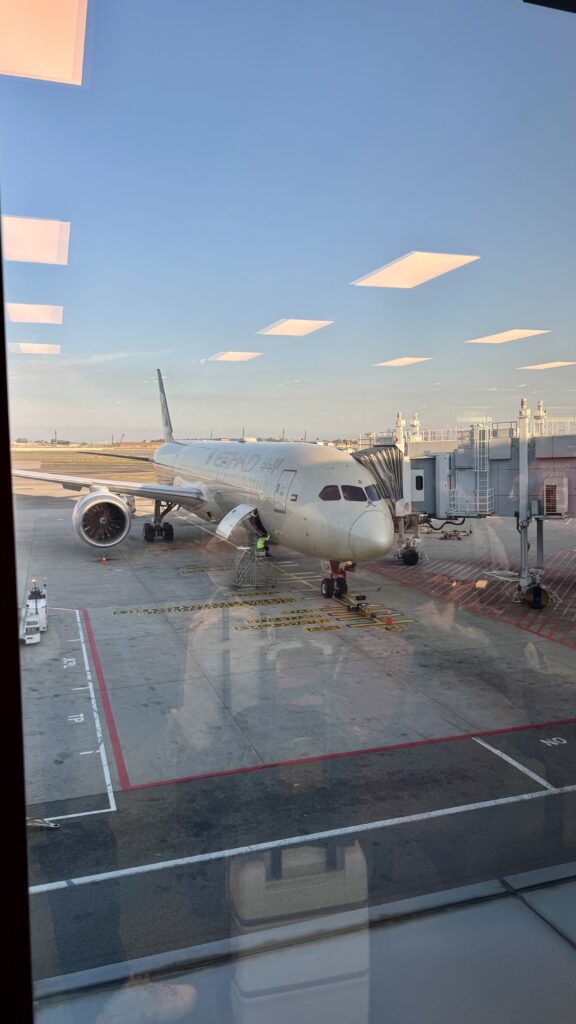
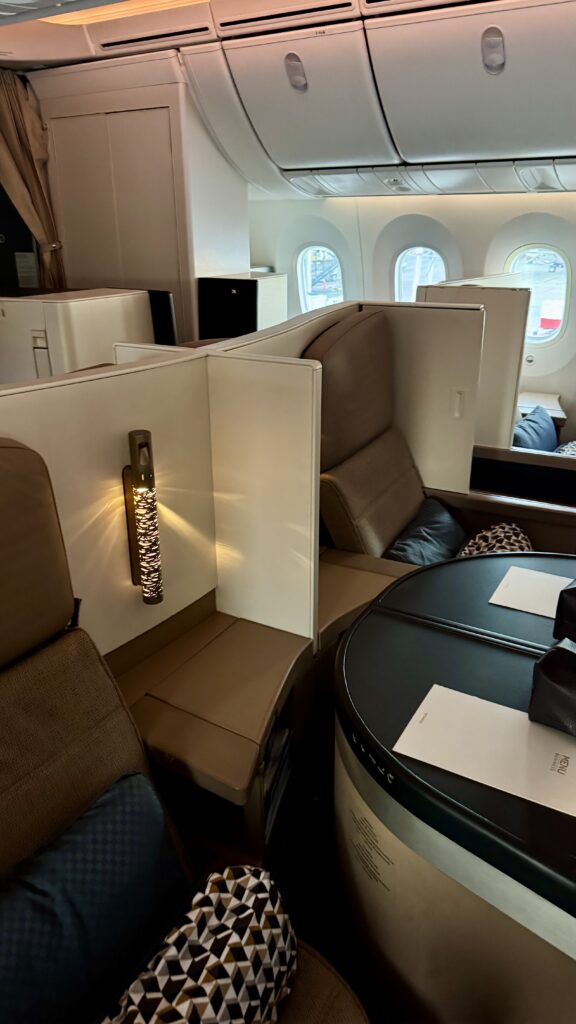
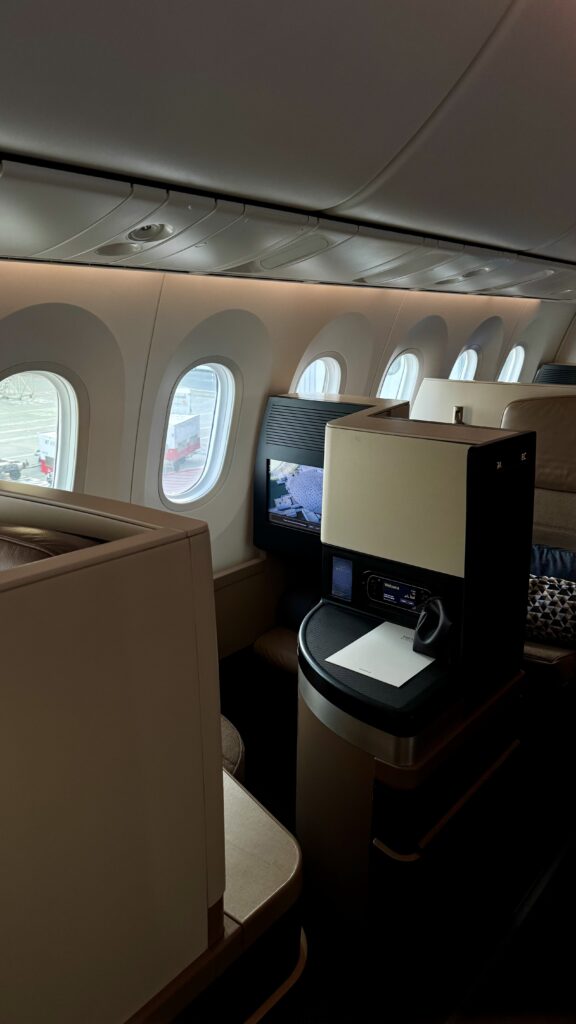
We had seats near the aisle in the second-to-last row. That worked well because there was virtually no foot traffic during the flight. A moveable divider covered the seat from the shoulders down to the feet. It created a private feel without making the seat claustrophobic. Privacy was genuinely good.
The cabin lighting was another highlight. You can cycle through different moods directly from the seat terminal. The terminal also controls the seat position, IFE, and window shades. It is intuitive and easy to use.
As with every 787, the electronically dimmable windows are a mixed blessing. You can control them individually in theory, but the crew usually dims them collectively for much of the flight. That remains a small but consistent frustration if you book a window seat for the view.
Sitting backwards sounds stranger than it feels. You notice it during takeoff and landing, then you stop thinking about it.
777: Abu Dhabi to Frankfurt
The contrast became obvious the moment we boarded the 777. The seat looked dated, the finishes felt older, and the whole cabin gave off a previous-generation vibe. That is harder to ignore when you have just stepped off the Dreamliner.
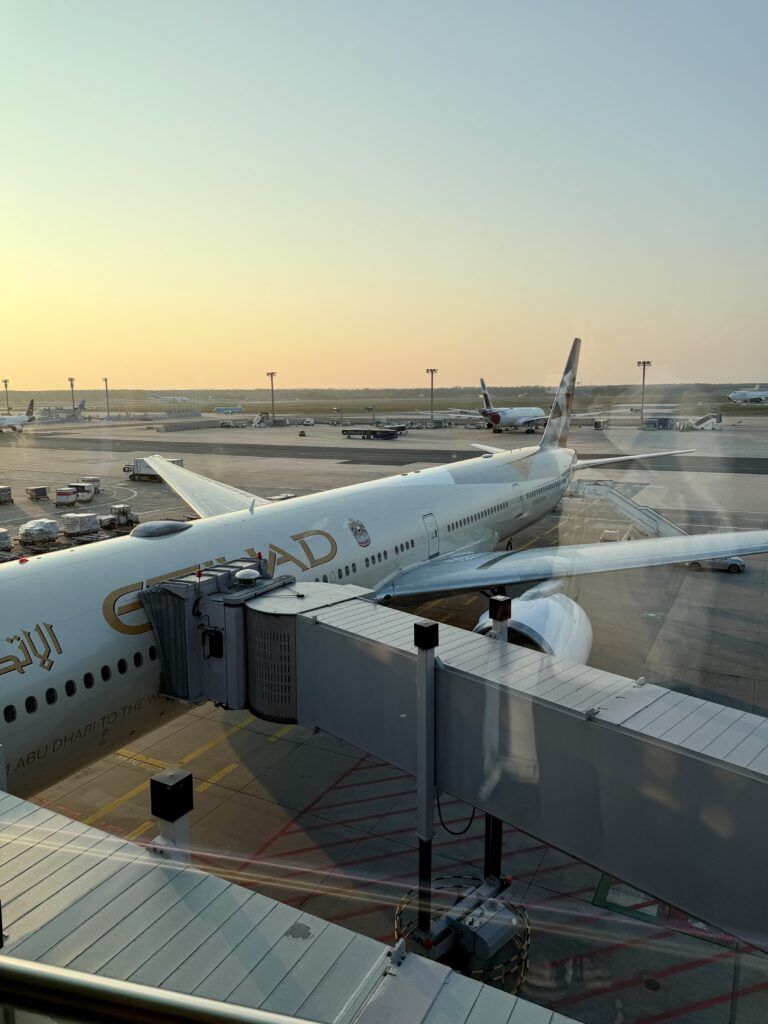
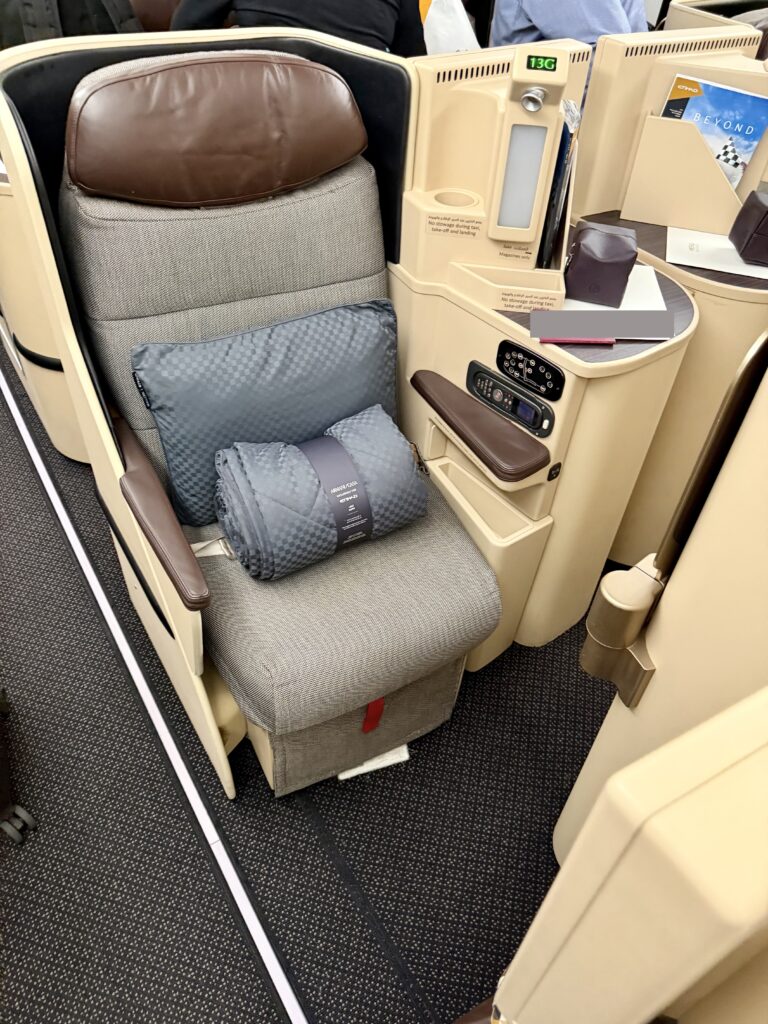
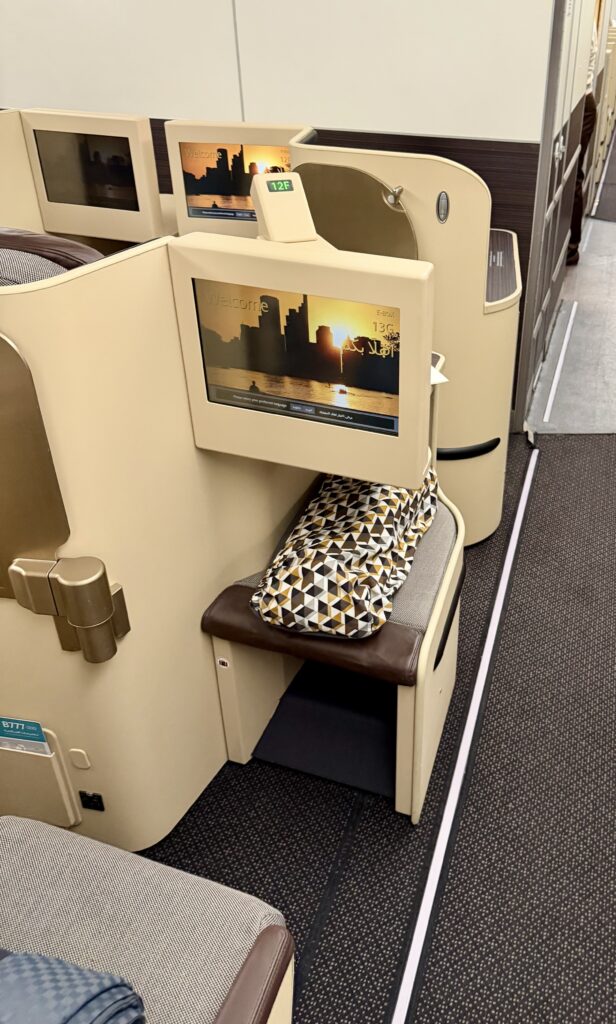
Still, Etihad gets the fundamentals right. This is still a full 1-2-1 configuration with direct aisle access for every passenger. Even in 2026, not every airline guarantees that.
For taller passengers, the older seat has one unexpected advantage. The design feels more open and less integrated into the cabin shell. In particular, the window seats have a visible gap between the seat and the window wall. That creates extra room to shift around and stretch out.
At 195 cm, I actually found the 777 easier to sleep in than the 787. The bed itself is not better. The surrounding space simply gives you more freedom to move. I managed around three hours of sleep on each leg. Both flights were comfortable, and the mattress pad plus Armani blanket helped a lot.
This is still one of the areas where Gulf carriers tend to outperform much of the long-haul market. The bedding is consistently there, and it is consistently good.
The Seat: A Few Details Worth Knowing
On the 787, the staggered configuration means window seats and aisle seats are genuinely different products. Our aisle-adjacent seats felt spacious and private — the moveable shoulder divider is one of those understated features you appreciate once you’ve used it. The electric terminal controls everything: lighting, shades, seat position, IFE. It’s intuitive. At 195cm, turning inward to sleep means your knees eventually meet the side wall — manageable, but worth knowing if you’re tall and light-sleeping.
The 777 is the more accommodating sleep environment for taller travellers, though you trade the sleek feel of the Dreamliner for something that visually feels more assembled than designed. It still reclines into a flat bed, still has the mattress pad, and still works — it just doesn’t look the part.
Food: A Genuine Standout
Etihad’s dining is one area where the gap between expectation and reality closes decisively in the airline’s favour.
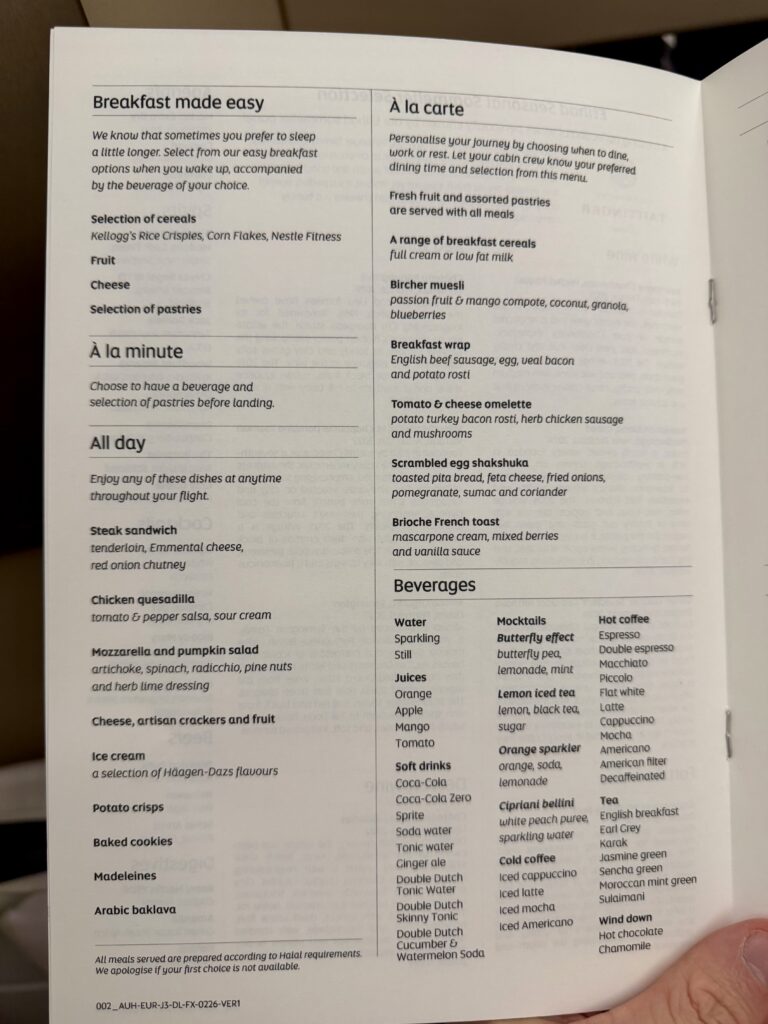
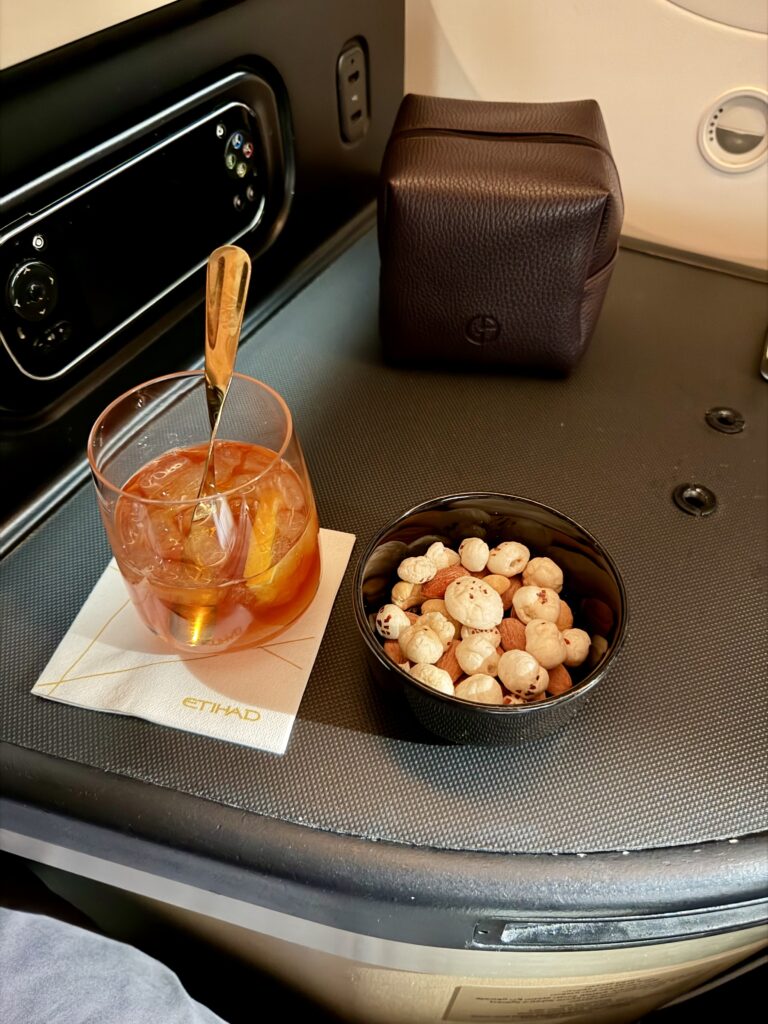
The first leg offered full à la carte dining with no fixed service window — you eat when you want, which is how it should work. We started with the sesame-crusted tuna tataki (pickled daikon, radish, cucumber, wasabi mayo) — precise, light, and well-executed — followed by the grilled beef tenderloin with mash, green beans, and a properly reduced jus. The tenderloin arrived at the right temperature and actually tasted like steak. Dessert was the cheese course. I started the evening with an Old Fashioned — a well-made one — while the boarding door was still being closed, and that set the tone for the rest of the leg.
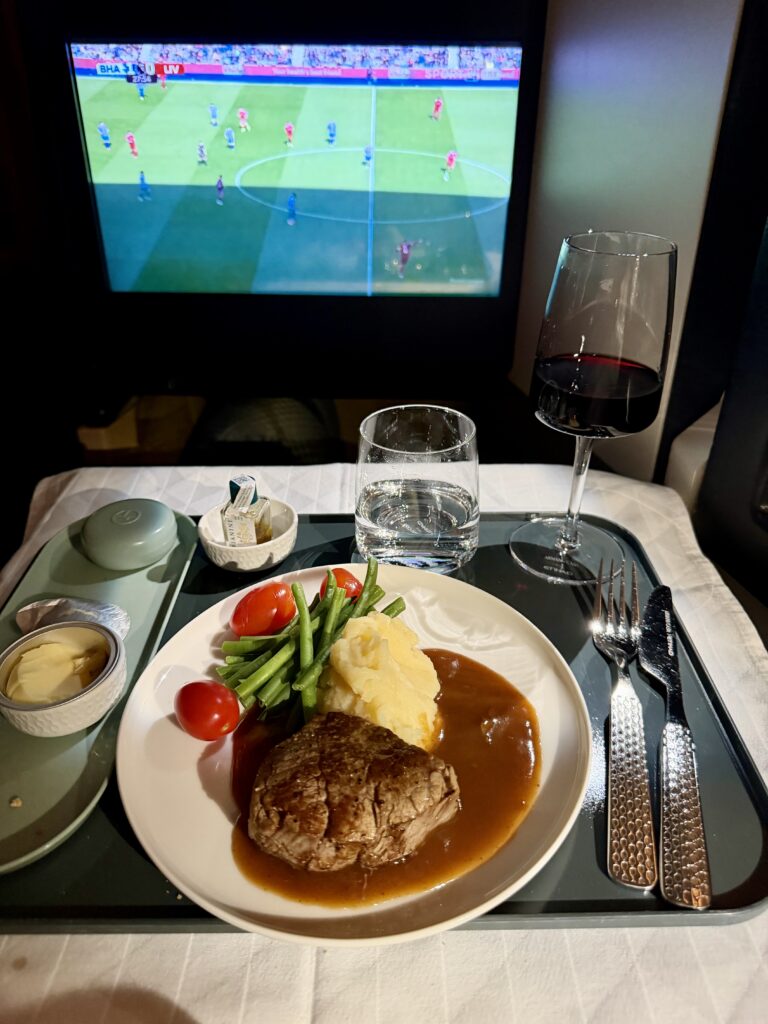
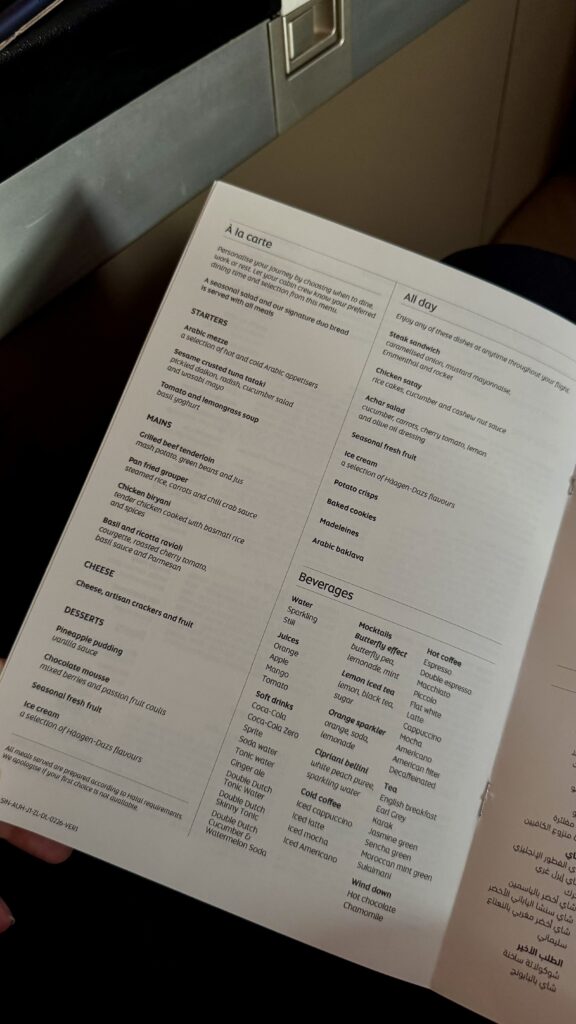
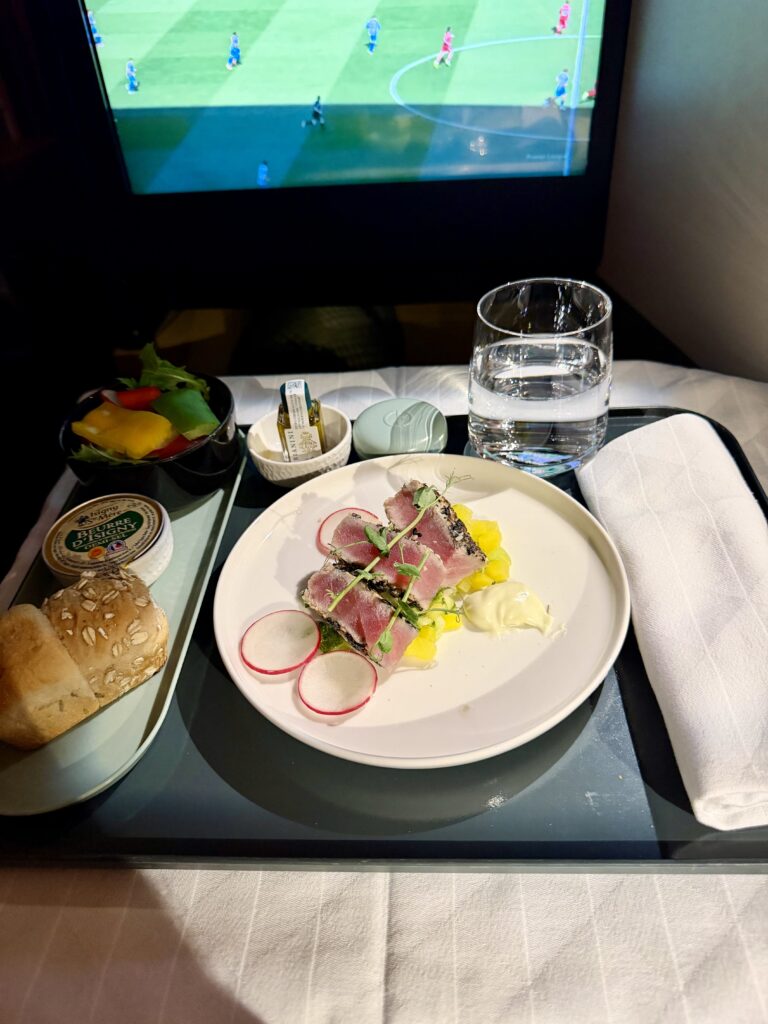
One honest note: food is prepared on board, not reheated. On busy departure windows when every passenger orders immediately after takeoff, there can be a short wait for your main course. It’s worth it; don’t be deterred.
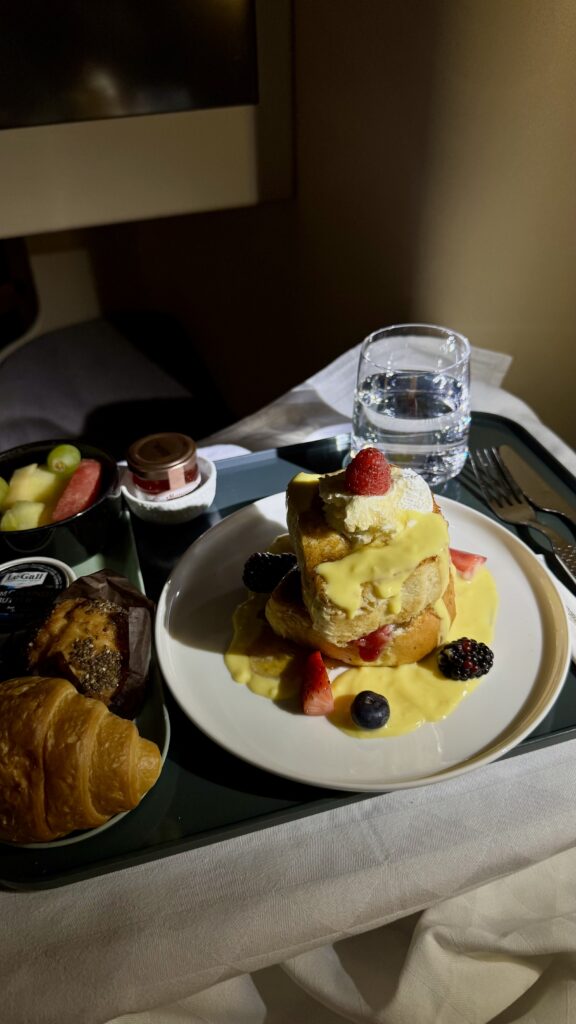
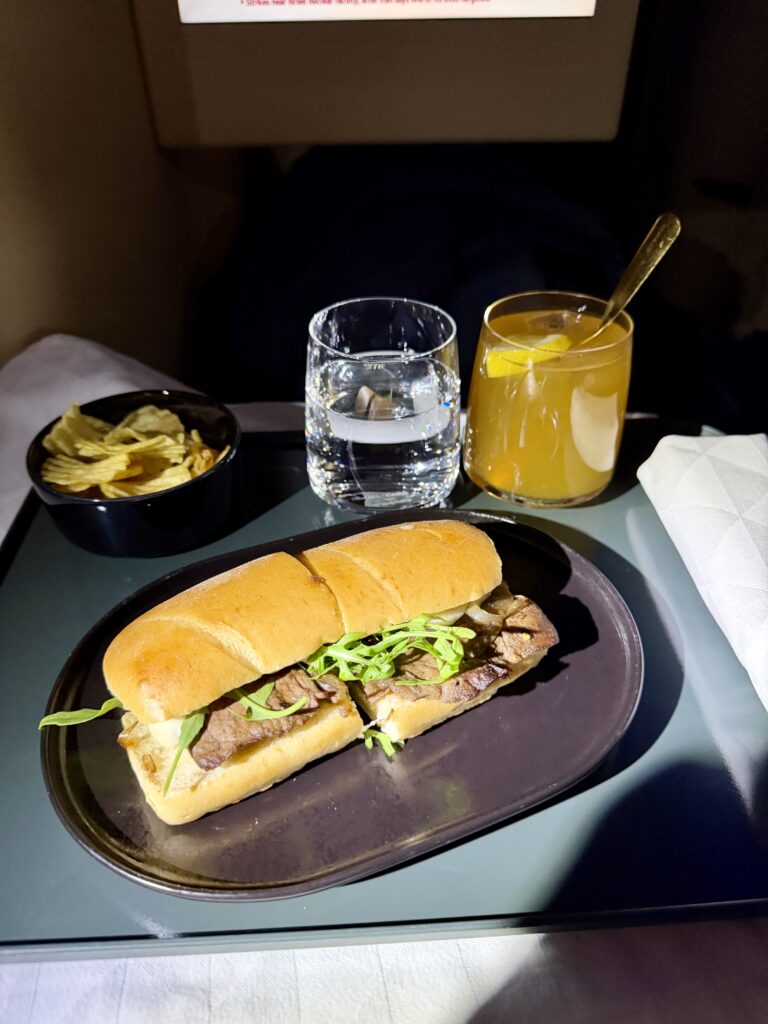
The second leg departed at 02:35 local time. We went straight to the all-day dining menu, took the steak sandwich — caramelised onion, Emmenthal, mustard mayo, rocket — and went to sleep. Breakfast was from the set menu: a shakshuka and a breakfast burrito, with French toast added on request. The crew checked availability on their iPad, confirmed it worked, and then delivered both courses in sequence with nothing requiring a reminder. It just happened. The dinner on leg one edges out the breakfast on leg two, but both were meaningfully better than what most business class cabins serve.
The Wine List
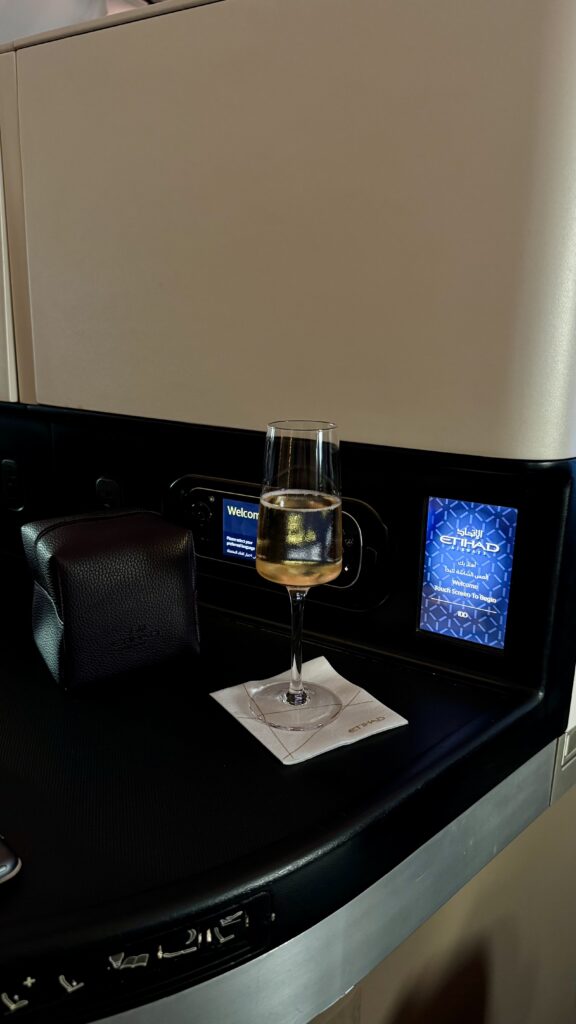
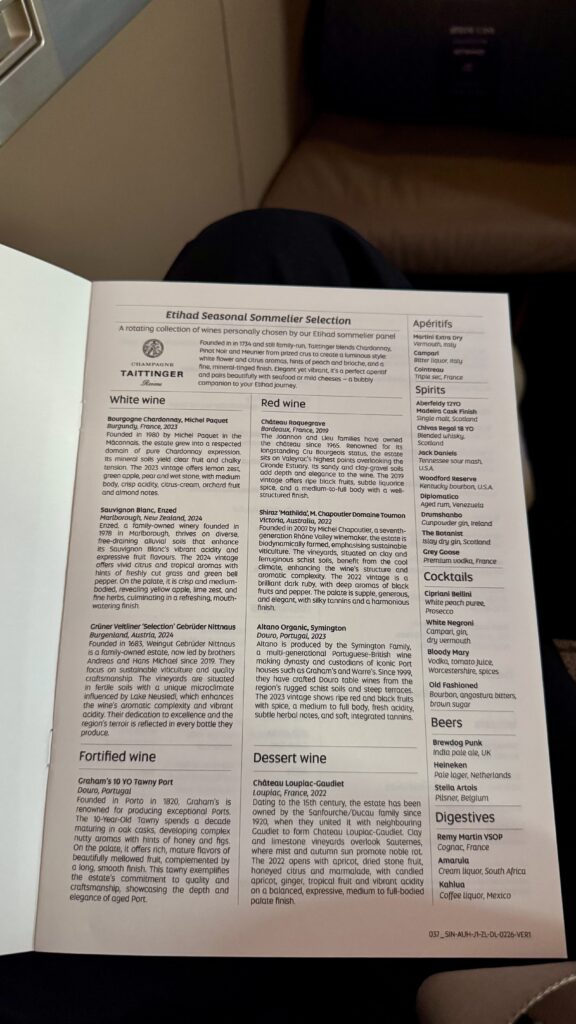
Etihad operates a rotating Sommelier Selection rather than a fixed list, and the curation is serious. On this routing: Taittinger on arrival, a Bourgogne Chardonnay from Michel Paquet and a Marlborough Sauvignon Blanc from Enzed among the whites, a Grüner Veltliner from Weingut Gebrüder Nittnaus (Burgenland) as an interesting addition, a Château Roquegrave Bordeaux 2019 and a biodynamic Shiraz from M. Chapoutier’s Tournon estate among the reds, Altano Organic from the Symington family as an additional red option, and Graham’s 10-Year Tawny alongside a Château Loupiac-Gaudiet as dessert and fortified options. The spirits list runs from Aberfeldy 12YO Madeira Cask through to The Botanist gin and Diplomatico rum. Cocktails include an Old Fashioned, White Negroni, Bloody Mary, and Cipriani Bellini.
For an airline that leans heavily into its Gulf identity, the wine programme shows real range and thought.
Service: Where Etihad Consistently Wins
The crew served welcome drinks while economy boarding was still underway. They used our names throughout both flights, but never in a forced or performative way. Requests were handled quickly and naturally.
On the second leg, I asked to add French toast to an already ongoing breakfast order. One crew member checked the request on an iPad, confirmed it, and that was it. What impressed me even more was what happened afterward: every crew member seemed to see the same information. Handovers were invisible. There was no “let me check with my colleague” moment. Whoever you spoke to already knew what was going on.
That kind of operational coherence turns good service into genuinely great service.
There was one inconsistency. Pajamas and slippers were not proactively offered on either leg. On the first flight, we asked and received them without any issue. We then reused the same pair on the second leg. Still, at this level, that feels like a miss. Competing Gulf carriers often distribute them before takeoff, even on shorter sectors.
The Armani amenity kit, however, is excellent. We received two of the same colour, which is minor, but in premium cabins small details do matter.
If you want a comparison point, our Qatar Airways 787 Business Class Review shows where Qatar still leads on hard product and small touches.
Entertainment & Connectivity
Etihad has live TV across its business class fleet, which I would normally note and not particularly care about. On this flight, eating perfectly cooked beef tenderloin at 38,000 feet while watching Premier League live is a specific experience that’s worth naming. It’s the kind of thing that pulls your attention when you’d normally have it on a film or podcast.
WiFi was available on both legs, but differently. On the first leg, complimentary access was limited to messaging via your Etihad account — functional for keeping in touch, but not full bandwidth. On the second leg, all business class passengers received a WiFi voucher for unrestricted access. That inconsistency between sectors on the same ticket isn’t a dealbreaker, but it’s slightly jarring when connectivity is increasingly treated as a baseline expectation.
Abu Dhabi Transfer
We used the Priority Pass lounge — the only non-Etihad option in Abu Dhabi — which was not impressive. The transfer itself was seamless: security fast, terminal quiet. The emptiness is partly a function of current regional disruption rather than a permanent feature, so it’s not a fair benchmark. Under normal circumstances, AUH is a clean, functional airport for a transit — not a destination in itself, and less interesting as a stopover than Doha, but efficient.
Etihad’s Three Active Business Class Products
It’s worth understanding what you might actually book before you fly. Etihad currently operates three distinct business class configurations simultaneously. The older 777 product — which we experienced on the AUH–FRA sector — is the most dated. The 787 Business Studio, which we flew SIN–AUH, is the staggered alternating-seat layout described throughout this review. And then there’s a third, newer generation: Collins Aerospace Elements suites, now entering service on newly delivered 787s. These feature full-height privacy doors, a reverse-herringbone layout, wireless charging, and 4K screens — a substantively different product. They were first deployed on North American routes (Boston, Chicago, Washington DC) in 2024, with a broader fleet-wide programme underway.
The airline is running three active configurations, which isn’t inherently problematic — fleets transition over years, not overnight. But Etihad could do more to make this visible at the point of booking. Which version you get on a given route is not always clear, and the gap between the oldest and newest products is wide enough to matter.
Verdict
Etihad Business Class is excellent — outstanding food, the best in-flight service of any carrier I’ve flown recently, and a crew system that operates with genuine coherence. Against Qatar, Etihad wins on both food and service; Qatar wins on hard product (the enclosed suites are better, the seats are larger, and the small touches like pajamas arrive without being requested). Qatar’s Doha hub is also a more interesting layover if that matters to you.
Would I fly Etihad again? Without question. But the aircraft matters. The older 777 product is showing its age and if you can avoid it, you should. The 787 Business Studio is a solid, comfortable product. And if the new Collins Elements suites are available on your routing — those are the version worth specifically seeking out.